
Polar Verity Sense - opinion from a professional perspective
Author: Silaghi Darius (National Champion distance runner of the Margitsziget AC)
Thanks to Polar's official Hungarian distributor, Ergóméter Kft., we were able to test the Finnish manufacturer's new type of heart rate monitor, which surprisingly became a part of my everyday life, especially during longer, intense workouts.
Introduction
Polar Verity Sense is an improved version of the popular standalone optical heart rate monitor, Polar OH1. The new device comes with a number of new features, improved capabilities and an updated design to meet the needs of athletes and fitness enthusiasts.
Those familiar with the highly accurate Polar OH1, often considered the benchmark for optical heart rate monitoring, know that the OH1 has delivered outstanding performance – often outperforming even traditional chest straps, especially in cooler weather. While the competition is promising, Polar’s product continues to lead the market and shows why Polar has been the gold standard in heart rate monitoring for over half a century.
What's new in Verity Sense?
Polar has introduced several important improvements:
- Longer battery life : Up to 20 hours of use on a single charge, compared to the OH1's 8-hour limit.
- Longer range : The range has been increased from 75m to 150m, ideal for team sports where data is captured along the sideline.
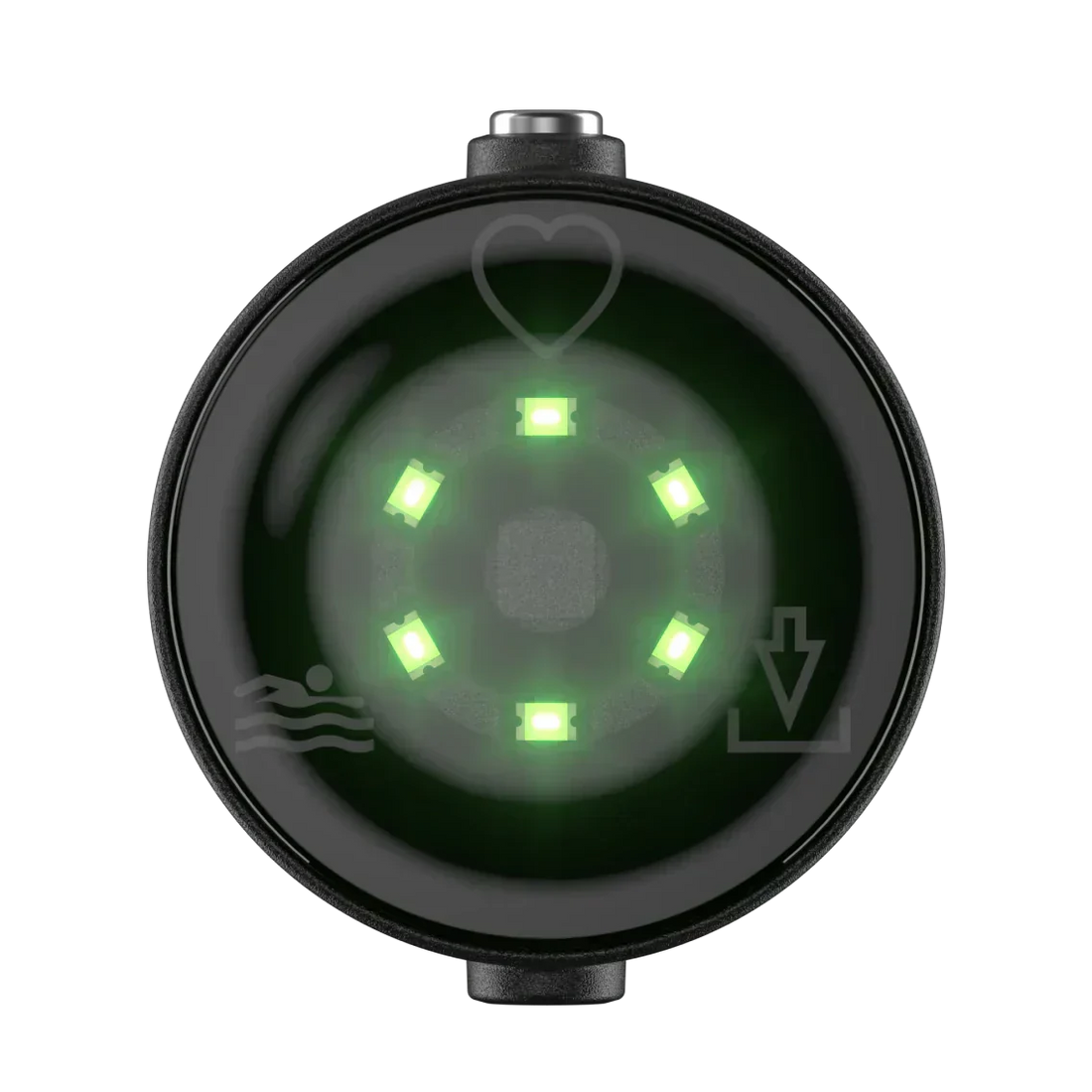
- Swim Mode : New mode specifically designed for swimmers, with clearly visible status lights on the back.
- Improved Strap Design : The redesigned strap minimizes the chance of the sensor rotating, eliminating one of the most common issues with the OH1 series: accidental slipping.
- Four times the storage: with 16MB of storage instead of 4MB, the device can store up to 600 hours of training, even if it is not synchronized.
These updates are a direct response to user feedback, making Verity Sense a well-thought-out and user-friendly development.
First impressions
Jakob Ingebrigtsen, one of the most successful middle-distance runners of our time, often measures his heart rate with a strap attached to his upper arm. As most of you know, I believe in the most accurate and precise monitoring and continuous data analysis, so I trained with the well-proven Polar H10, ECG-based chest strap, and I was even skeptical about heart rate monitors that can be attached to the arm. However, based on the first tests, the Verity Sense provided surprisingly accurate data and was easy to use. Here is a graph from the training when I started running 5x5 minutes, slightly slower than my threshold pace, at a pace of about 3:20. The goal was to keep my heart rate in the green zone, i.e. around 160 and not go significantly above it. As you can see, this was achieved:

It's honestly surprising that the device tracks the heart rate SO accurately. Unlike ECG chest straps, which track the electromagnetism of the heart, it measures heart rate in the traditional way, with strong green and red lights, for up to a watch.
So why is it better than an hour?
It's simple: a device whose sole purpose is to measure heart rate will, by its very nature, be much more accurate than one that also measures time, calculates pace, monitors altitude and temperature, and provides a lot of data and performs calculations every second, not to mention the fact that it simply measures over a much larger surface area and the LEDs that enable heart rate measurement are also larger.

And why is it better than a chest strap?
I am a hardcore H10 user. I have worn it for all my important training sessions for the past 5 years and I couldn't prepare without a heart rate monitor. As I mentioned in a previous article , one of the biggest advantages of Polar is its heart rate accuracy, and I want to take advantage of that. But why did I switch to the Verity Sense? The biggest advantage of the device is its simplicity. If you forget to put the sensor on after putting on your jacket or long sleeves, you can simply reach in through your finger and attach it. You don't have to soak it in water like you would with a chest strap. And most importantly: it doesn't interfere with my breathing, but some people can't stand the slight tightness in their chest, so they can't train with a traditional strap. This is much more comfortable, and there is no risk of the device rubbing, which is unfortunately a very important aspect for a workout longer than 1 hour, especially with a looser T-shirt, or for girls who are already tired of wearing a top/bra.

So you sacrificed yourself for the chest strap?
I wouldn't say that. Both are needed. For example, the 5-10 second delay that does NOT come from the Verity Sense itself, but rather from measuring the pulse rate of the blood pulsating in the veins. As I mentioned, chest straps do not measure pulse but work with ECG-like data, so they give a much more accurate picture. Effectively, we see the numbers on the display as pulse, or heart rate, but these are essential differences. The pulse can indeed be delayed by a few seconds, especially during partial distance training. For example, for 10x200, with a short rest if necessary, a traditional heart rate monitor watch would not provide satisfactory data. The Verity Sense would track the heart rate in a way, but the H10 would be accurate from the first seconds. In light of this, the Verity Sense is therefore approx. I would set it to intervals of 1.5-2 minutes or longer, and recommend at least 40 seconds of rest to ensure reliable data.

What else do you know?
The device is very easy to use, and you can choose from three different modes:
- Heart rate transfer to watch via Bluetooth and ANT+ (no, it doesn't just work with Polar devices, but with everything that supports either of the two standards, from treadmills to watches to bike computers)
- Heart rate measurement and recording
- Heart rate measurement and recording for swimming
The device provides information about which mode you are in, clearly visible LEDs and small icons. I always transferred the data to the watch, saved it there and synchronized it to Flow (Polar's software). Modes 2 and 3 are more for those who do not have a watch and want to save their data directly to the device. The renewed 16MB storage space may seem small in today's world, but since the Verity Sense only works with simple numbers in this case, it can hold more than 600 hours of training. For using the swimming mode, the swimming goggles clip, which is included in the box, is recommended!

Summary
They've addressed virtually every criticism of the OH1 while leaving its positive features intact. I officially have a new training partner for longer distances, tempo runs, and weekend long runs!